

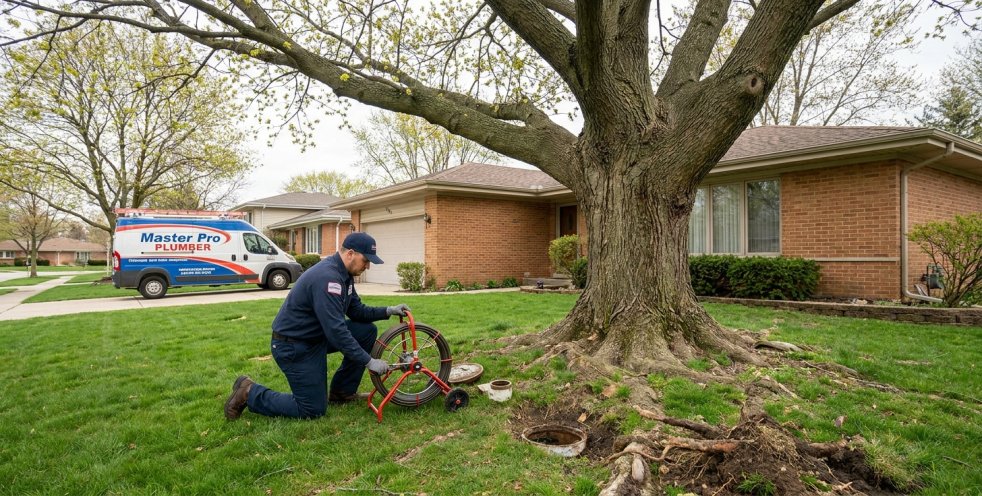
How Tree Roots Can Damage Your Pipes in Spring and What to Do About It
Every spring in Des Plaines, the ground thaws, rainfall picks up, and trees wake up from dormancy ready to grow. That seasonal shift is good news for your lawn. For your pipes, it can be the start of a serious problem.
Tree roots are naturally drawn to moisture and nutrients. Your underground pipes, especially older ones with small cracks or loose joints, give off exactly what roots are looking for. Once roots find a way in, they grow fast and cause damage that gets worse every season you wait.
Why Spring Is the Most Dangerous Season for Root Intrusion
During winter, root growth slows down significantly. When temperatures rise in March and April, roots resume aggressive growth just as the ground is saturated with snowmelt and spring rain. That combination of moisture and biological drive sends roots searching outward in every direction.
In the Des Plaines area, mature trees like silver maple, willow, elm, and cottonwood are especially common in older neighborhoods. These species have aggressive, wide-spreading root systems that are well-known for targeting sewer and water lines.
Older homes in the area, many built in the 1950s through 1970s, often have clay tile or cast iron sewer lines that have developed small cracks over decades. Those cracks are exactly the entry points that roots are looking for.
How Roots Actually Damage Your Pipes
Root intrusion is not a single dramatic event. It is a slow process that compounds over time.
- Fine root tips enter through hairline cracks, joint gaps, or deteriorated seals
- Once inside, roots absorb the moisture and nutrients in wastewater and grow rapidly
- Root masses expand and put pressure on pipe walls, widening existing cracks
- Debris like grease, toilet paper, and solids catch on root clusters and cause blockages
- In advanced cases, roots can collapse a pipe section entirely
What starts as a small intrusion can turn into a full sewer backup or a collapsed line within a few seasons. The damage tends to accelerate each spring as the root system grows larger.
Warning Signs You Should Not Ignore
Root intrusion rarely announces itself until the damage is already significant. Knowing what to look for gives you a chance to act before a minor issue becomes an expensive repair.
- Slow drains throughout the house, not just in one fixture
- Gurgling sounds from toilets or floor drains when water runs elsewhere
- Sewage odors coming from drains or from soft spots in the yard
- Recurring clogs that keep coming back even after clearing
- Unusually lush or green patches of grass above your sewer line in the yard
- Toilets that flush sluggishly or back up without explanation
If you are noticing any of these signs in spring, root intrusion is one of the most likely causes and it deserves a professional diagnosis, not just a temporary fix.
Which Pipes Are Most at Risk in Des Plaines Homes
Not every pipe is equally vulnerable. The risk depends on the age of your home, the pipe material, and what trees are growing nearby.
- Clay tile sewer lines (common in homes built before 1970) are highly susceptible because joints shift and crack over time
- Cast iron drain lines develop internal corrosion that weakens pipe walls and creates entry points
- Older PVC connections with improper joints or glue failures can also allow root entry
- Any line running within 20 to 30 feet of a large mature tree carries an elevated risk
Des Plaines has a large stock of mid-century homes with original underground plumbing. If your home has never had a sewer inspection, there is a real chance roots have already made some progress.
What a Professional Inspection Actually Involves
The only reliable way to know what is happening inside your sewer line is a video camera inspection. A waterproof camera is fed through the line from a cleanout access point, giving a real-time view of the pipe interior.
A camera inspection can identify root intrusion at any stage, locate cracks or joint failures, and show the overall condition of the line. It takes the guesswork out of the diagnosis completely.
If roots are found, the appropriate response depends on how far the intrusion has progressed:
- Early-stage intrusion can often be cleared with hydro-jetting, which uses high-pressure water to cut through root masses and flush debris
- Moderate intrusion may require jetting combined with root treatment to slow regrowth
- Advanced damage or a collapsed section may call for trenchless pipe lining or targeted pipe replacement
Practical Steps Homeowners Can Take Now
You cannot stop trees from growing, but you can reduce the risk and catch problems early.
- Know where your sewer line runs and which trees are growing near it
- Avoid planting new trees or large shrubs directly above underground utility lines
- Schedule a sewer camera inspection if your home is more than 30 years old and has never had one
- Have your line inspected every few years if you have large maples, willows, or elms on your property
- Do not ignore recurring slow drains or backups, especially if they appear or worsen each spring
Catching root intrusion at the early stage is significantly less expensive than dealing with a full sewer backup or a collapsed line. Prevention and early diagnosis are always the better investment.
Get a Diagnosis Before Spring Gets Ahead of You
Master Pro Plumber helps homeowners and businesses throughout Des Plaines identify and resolve root intrusion before it turns into a plumbing emergency. We use camera inspection equipment to get a clear picture of what is happening inside your lines, and we give you honest recommendations based on what we actually find.
If your drains have been slow, your toilets have been acting up, or you simply have not had your sewer line looked at in years, this spring is the right time to schedule an inspection. Call (847) 641-2542 to book a camera inspection or get a quote. The earlier you catch it, the simpler the fix.